17 May 2026 · 12 min read
How to buy property in Sicily: a 2026 guide for foreigners
Foreigners can buy almost anywhere in Sicily. The hard part isn't the law — it's finding the right town, the right house, and the right team. Here's the full path, start to finish.
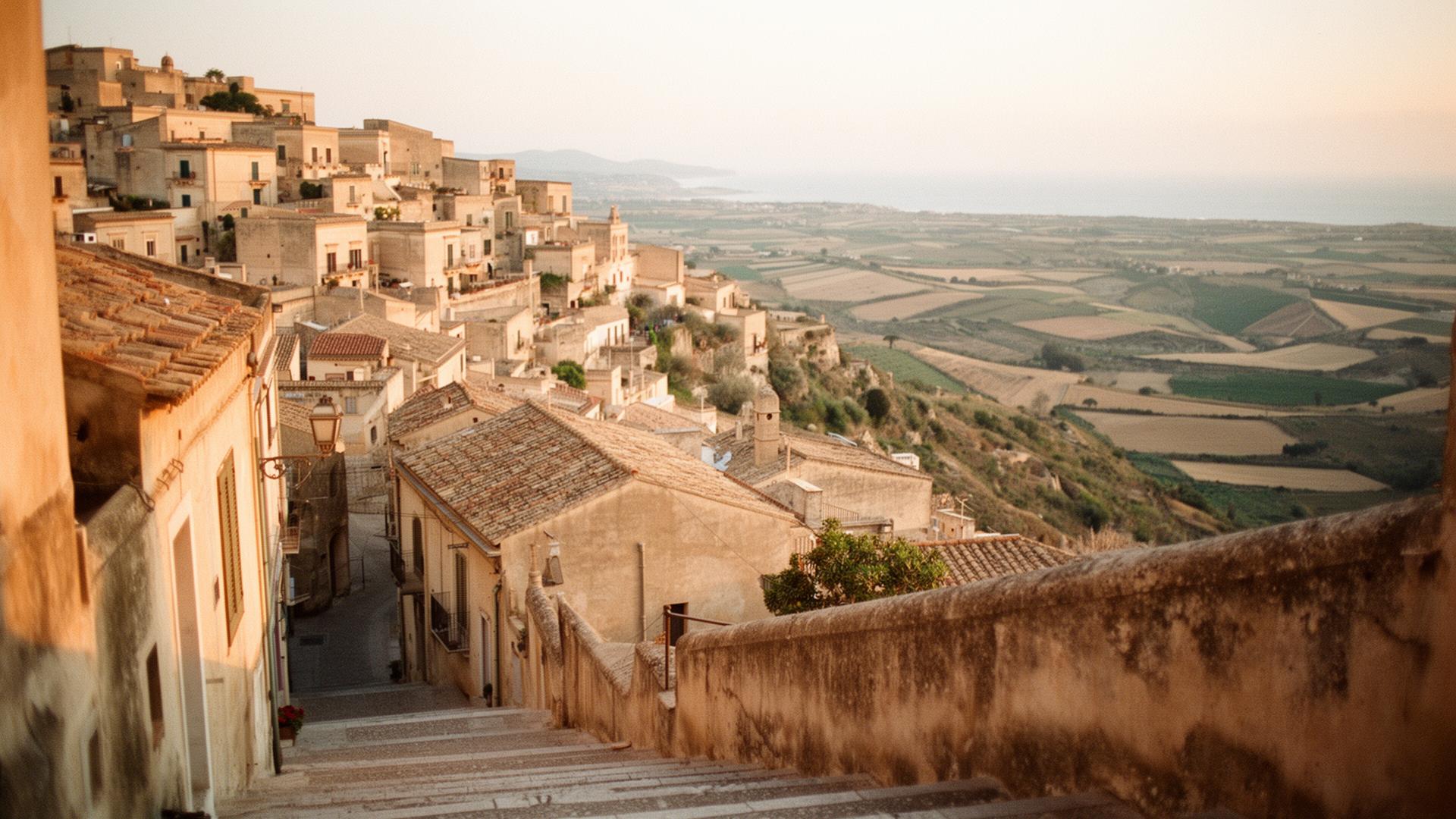
Sicily has never been more open to foreign buyers. €1 house schemes, remote-work visas, and a generation of mayors who want their towns repopulated have made the island one of the most accessible places in Europe to own a home. But "accessible" is not the same as "simple". This is the path, in the order you actually walk it.
Can foreigners buy property in Sicily?
Yes. Italy operates on a principle of reciprocity: if your home country allows Italians to buy property there, you can buy in Italy. That covers citizens of the US, UK, Canada, Australia, the EU, and most of the rest of the world. You do not need residency. You do not need a visa to own. The only thing you genuinely need is a codice fiscale (Italian tax code) — that's it.
Step 1: Choose the right type of Sicilian property
This is the step everyone skips, and the one that costs the most when skipped. Sicily is not one market. It is at least four:
- The €1 house towns (Salemi, Mussomeli, Sambuca di Sicilia, Gangi, San Piero Patti for a coastal option). Cheap to acquire, expensive and slow to renovate, life unfolds in hill-town rhythm.
- The coast (Cefalù, Trapani, Siracusa). Higher prices, faster sales, summer tourism economy.
- The cities (Palermo, Catania). Apartments, services, airports, real winters of culture and noise.
- The countryside (Val di Noto, the interior). Farmhouse rebuilds, often requiring a car and patience.
Before you look at a single listing, decide which of these you're buying into. The houses behave differently. The communities behave differently. The exit market — if you ever need to sell — behaves very differently.
Step 2: Write your non-negotiable list
Before you fall in love with a photo, write down what you actually need a place in Sicily to give you. This list is deeply personal — what I love, you may dislike, and vice versa.
When I was looking, my non-negotiables were:
- Less than an hour from an airport
- Less than 40 minutes from the beach
- An existing expat community
- Warmer weather (so, western/southern Sicily over the interior)
- A lower budget
- A hospital, pharmacy, and a few real restaurants in town
- A population of at least 7,000
Yours will look completely different. Maybe you need a train station, a music scene, a school, mountain hiking, or absolute quiet. Write the list before you start scrolling listings — otherwise the listings write it for you.
PS: this is also your filter for Step 3. When you spend a month in a town, ask yourself constantly — does it pass the vibe check? A place can tick every box on paper and still feel wrong. Trust that.
Step 3: Spend a month there first
The single biggest predictor of regret is having only seen the house on a four-day scouting trip in May. May is the easiest month to fall in love with Sicily. February is the month that tells you the truth — which streets get no sun, which houses are damp, which neighbourhoods empty out, where you can actually get groceries on a Sunday.
Mid-term rentals exist for exactly this reason. A month in the town you're considering is the cheapest due diligence you'll ever do. (This is what we do at SalemiStays — but the principle holds wherever you're looking.)
Step 4: Codice fiscale and the paperwork basics
Before you make an offer, line up:
- Codice fiscale. Free, obtained from the Agenzia delle Entrate or any Italian consulate. Takes a week. This is the only document you truly need to buy.
- A way to send euros. You do not need an Italian bank account to purchase. I used Wise to convert and send my funds in euros, and I still use it to pay my electricity bill. You can open a local Italian account later if you want one — it's not a prerequisite.
- Notaio (notary). Required by Italian law for every property transfer. Your real estate agent will recommend one — in Salemi I worked with Vita Spano and recommend her.
- Commercialista (accountant) if you plan to rent the property or take residency. Worth the few hundred euros a year.
Step 5: Where to find houses for sale in Sicily
There are four real channels, in rough order of how Italians actually use them:
- Idealista.it and Immobiliare.it — the two main listing portals. Cast wide and filter by region.
- Local agencies in the town. Walk in, speak slowly, leave your number. Many of the best houses never reach the portals. In Salemi, I worked with Fabrizio Internicola (fabriziointernicola.it) and recommend him without hesitation.
- The comune's €1-house website. Each participating town runs its own scheme with its own rules — Salemi, Mussomeli, Sambuca di Sicilia, and San Piero Patti all differ on deposit, renovation deadline, and selection process.
- Word of mouth. This is why staying first matters. The bar owner knows whose nonna just passed. The geometra knows which house has good bones.
Ignore the agency-aggregator sites that target foreigners specifically — markups are heavy and the inventory is recycled.
Step 6: Viewing, surveyor, and negotiation
Never buy without an in-person viewing. Photographs hide damp, hide structural movement, hide the neighbour's goat. Bring a local geometra (surveyor) to any house you're seriously considering — they cost €200–€500 and will save you €20,000 in surprises.
Negotiation in Sicily is expected. Listed prices on private sales are typically 10–20% above the seller's real number. €1 houses are non-negotiable on price (the price is €1) but you are negotiating on renovation deadlines and the size of the comune's deposit.
Step 7: The compromesso (preliminary contract)
Once you and the seller agree, you sign a compromesso di vendita — a legally binding preliminary contract. You typically pay 10–30% as a deposit (the caparra). For my purchase I paid 25%, and we closed nine months later. If you walk away, you lose the deposit. If the seller walks away, they owe you double.
Register the compromesso with the Agenzia delle Entrate. This protects you against the seller selling to someone else in the gap between preliminary and final.
Step 8: The rogito (final deed)
The rogito is signed in front of the notary. The gap between compromesso and rogito varies widely — it depends entirely on what you and the seller agreed, and on whether any paperwork on the house still needs to be sorted (inheritance, condono, missing certificates). Mine was nine months. Yours might be three, or twelve. Plan around what's actually agreed, not a generic timeline.
On the day, you pay the balance, the notary registers the transfer, and the keys are yours. If your Italian isn't fluent, bring a translator — the notary is legally required to ensure you understand every clause.
Cost of buying property in Sicily
Budget roughly 10–15% on top of the purchase price for the full transaction. In Salemi, the notary's bill alone tends to come in around 10–15% — because it bundles the home taxes (imposta di registro, ipotecaria, catastale) along with the notary's own fee. Broadly:
- Notary fees + registration and cadastral taxes: usually 10–15% combined on lower-priced properties (the fixed taxes weigh more, proportionally, when the price is small)
- Agency commission (if used): 3% + VAT, paid by buyer
- Geometra, translator, legal review: €1,000–€3,000
For a €1 house, the transaction itself is cheap in absolute terms. The renovation is the real cost — we wrote about that here.
Common mistakes foreigners make when buying in Sicily
- Buying on the first trip. Every regret story starts here.
- Skipping the geometra. Save €300, lose €30,000.
- Thinking the renovation will be done in a few months. This is Sicily. Plan in years, not months. Double whatever the contractor tells you, then add winter.
- Underestimating the rogito timeline. It can easily be six to twelve months after the compromesso, especially if paperwork on the house needs sorting.
- Picking the wrong town. Salemi, Mussomeli, Sambuca di Sicilia, and San Piero Patti are not interchangeable. The community you're joining matters more than the house.
- Forgetting it's a life, not a project. A house in Sicily is only a good purchase if you actually want to spend time there.
The shortcut: live there first
If you take one thing from this: live there before you buy. A month in the town tells you everything a hundred listings cannot. That's the entire premise of SalemiStays — and whether you end up buying through a €1 scheme, a private sale, or never at all, the month is the part of the journey worth doing properly.
Frequently asked
- Can foreigners buy property in Sicily?
- Yes. Italy applies a principle of reciprocity, so citizens of the US, UK, Canada, Australia, the EU, and most other countries can buy property in Sicily without residency or a visa. The only document you genuinely need is an Italian tax code (codice fiscale) — you do not need an Italian bank account to complete the purchase.
- Can Americans buy property in Sicily?
- Yes. US citizens can buy property anywhere in Sicily without restriction. You don't need residency or a visa to own. You will need a codice fiscale, which any Italian consulate in the US can issue for free.
- How much does it cost to buy a house in Sicily?
- Beyond the purchase price, budget around 10–15% for transaction costs. On lower-priced properties this is mostly the notary's bill, which bundles their fee with the home taxes (registration, cadastral, mortgage). Add agency commission if applicable (3% + VAT), plus surveyor and legal fees. The €1 house schemes are cheap to acquire but typically require €30,000–€90,000 in renovation.
- Is it safe to buy property in Sicily?
- Yes, provided you use a qualified notary (mandatory under Italian law) and a local geometra (surveyor) for any house you seriously consider. The notary is neutral and ensures clear title. The geometra catches structural and paperwork issues before you commit.
- How do I find property to buy in Sicily?
- The main channels are Idealista.it and Immobiliare.it (listing portals), local agencies in the town you've chosen, the comune's official €1-house website for participating towns, and word of mouth — which is why spending a month in the town first is so valuable.
- buying property
- sicily
- 1 euro house
Keep reading
Top things to do in Salemi, Sicily: a local guide
Salemi is a medieval hill town in western Sicily — small, slow, and full of layered history. Here are the experiences worth planning a trip around.
What it actually costs to renovate a €1 house in Salemi
The headline is €1. The real number is somewhere between €30,000 and €90,000 — and here's where it goes.